
Chain, Belt or Wall-Mount Opener: Which One Actually Fits Your Garage
Chain, belt and wall-mount openers all raise the same door, but they behave very differently once winter hits and once you're trying to sleep above the garage. Here's how to pick the right drive type for your Naperville home.
The Three Drive Types, In Plain Terms
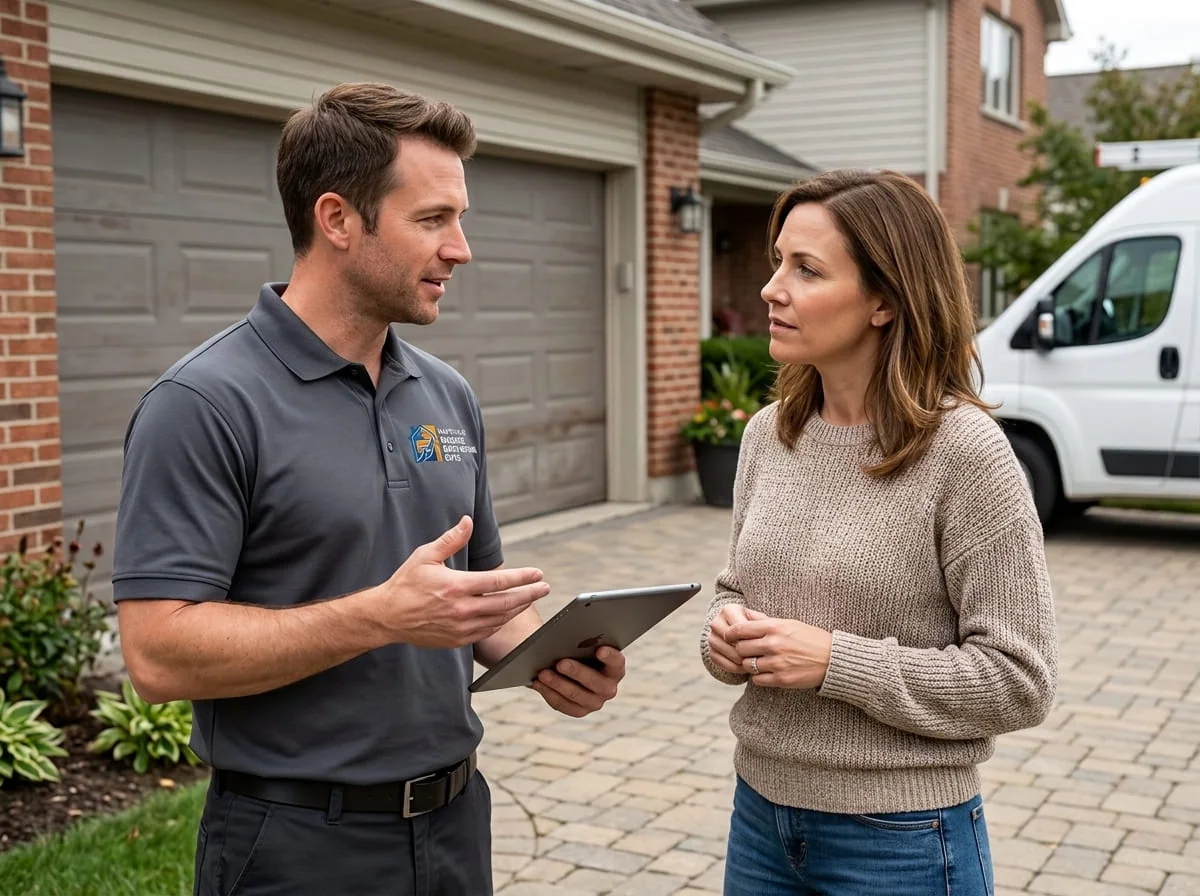
Every residential garage door opener on the market does the same basic job: a motor turns a drive mechanism, and the drive mechanism pulls a trolley along a rail, and the trolley pulls the door open or lets it down. What changes from model to model is what actually does the pulling. A chain-drive opener uses a metal chain, like an oversized bicycle chain, looped around a sprocket. A belt-drive opener replaces that chain with a reinforced rubber or polyurethane belt, often with steel or fiberglass cording inside it for strength. A wall-mount opener, sometimes called a jackshaft opener, skips the overhead rail entirely and mounts to the wall beside the door, turning the torsion spring shaft directly to raise and lower the door.
None of these three is objectively "the best" opener in every situation. Each one solves a different problem well, and each one has a real weakness that a homeowner should know about before it's installed in their garage, not after. We install and service all three, and the honest answer to "which one should I get" almost always depends on where the garage sits in the house, what the ceiling looks like, and how much the noise actually matters to the people living there.
Chain-Drive Openers: The Workhorse
Chain-drive openers have been the default choice for decades, and there's a reason they're still the most common opener we install in Naperville and Plainfield. The metal chain is strong, it's forgiving of a slightly out-of-balance door, and it's the least expensive drive type to manufacture, which keeps the unit itself affordable. For a heavier door, like a solid wood carriage-house style door or a double-wide door with a lot of insulation and steel in it, a chain-drive opener has plenty of margin to handle the load year after year without added strain.
The tradeoff is noise and vibration. Metal chain running over a metal sprocket, mounted to a metal rail, transmits sound efficiently through the rail into the ceiling joists and the framing above the garage. If the garage sits under a bedroom, a home office, or a bonus room, that vibration carries. It's not usually loud in the sense of a jarring bang, but it's a low mechanical rattle and hum that people who work from home or have a baby sleeping above the garage notice fast. Chain-drive units also need occasional lubrication to keep that chain running smoothly, and a chain that's run dry for a long stretch will get noticeably louder and can wear the sprocket teeth faster than it should.
Chain-drive is the right call for a detached garage, a garage with no living space above or beside it, or a homeowner who wants the most door-lifting capacity for the least cost and isn't worried about noise. It's a proven, simple mechanism, and a well-maintained chain-drive opener can run reliably for many years.
Belt-Drive Openers: The Quiet Option
Belt-drive openers do the exact same job as chain-drive units, with the same rail, the same trolley, and usually the same range of horsepower ratings, but the belt itself absorbs vibration instead of transmitting it. A reinforced belt doesn't clank against a sprocket the way a metal chain does, and it doesn't need the periodic lubrication a chain does, so there's less mechanical noise to begin with and less maintenance to keep it that way. For a garage that sits directly under a bedroom, or an attached garage where the wall backs up to a living room or kitchen, that quieter operation is often the single biggest reason a homeowner switches.
Belt-drive units used to carry a real price premium and a reputation for being less durable under heavy loads, but the belts used today are built with steel-reinforced cores that hold up well under normal residential use, including the heavier insulated steel doors common in newer Naperville subdivisions like White Eagle and Ashwood Park. The one place we still recommend caution is a very heavy custom wood door or an oversized door well beyond standard dimensions, where the extra tensile strength of a chain can matter. For a standard single or double garage door, a quality belt-drive opener holds up fine.
Cold doesn't bother a belt the way it bothers chain lubricant, either. Rubber and polyurethane belts stay flexible across the temperature swings this area sees, so there's no thickened grease slowing the mechanism down on a January morning the way there can be with an under-lubricated chain.
Wall-Mount (Jackshaft) Openers: The Space-Saver
A wall-mount opener throws out the overhead rail entirely. Instead of a trolley riding a track bolted to the ceiling, the unit mounts on the wall next to the door and connects directly to the torsion spring shaft, turning the shaft to wind or unwind the springs and raise or lower the door. Because there's no rail hanging down from the ceiling, this style clears up the entire overhead space above the door opening, which is the main reason people choose it.
That matters most in three specific situations. First, garages with low ceiling clearance, common in some of the older homes near Downtown Naperville and the Historic District, where a standard rail-and-trolley opener may not have enough headroom to operate properly at all. Second, garages doing double duty as a home gym, workshop, or storage area, where an open ceiling means storage racks, a pull-up bar, or hanging equipment can go exactly where a rail would otherwise be. Third, doors with high-lift or vertical-lift track configurations, which raise the door higher than a standard track and often don't leave room for a conventional rail-mounted opener to sit correctly.
Wall-mount openers have real limitations, too. They only work with torsion-spring systems, since the whole mechanism depends on turning that spring shaft; a door running on old-style extension springs isn't a candidate without converting the spring system first. Because the opener is mounted at roughly door height instead of up near the ceiling, the control unit and wiring live in a spot that's more exposed to a bumped car, a stray bike, or a curious kid, so placement and clearance from the door's swing path need to be planned carefully during installation.
Noise: Why It Matters More Than You Think in Naperville
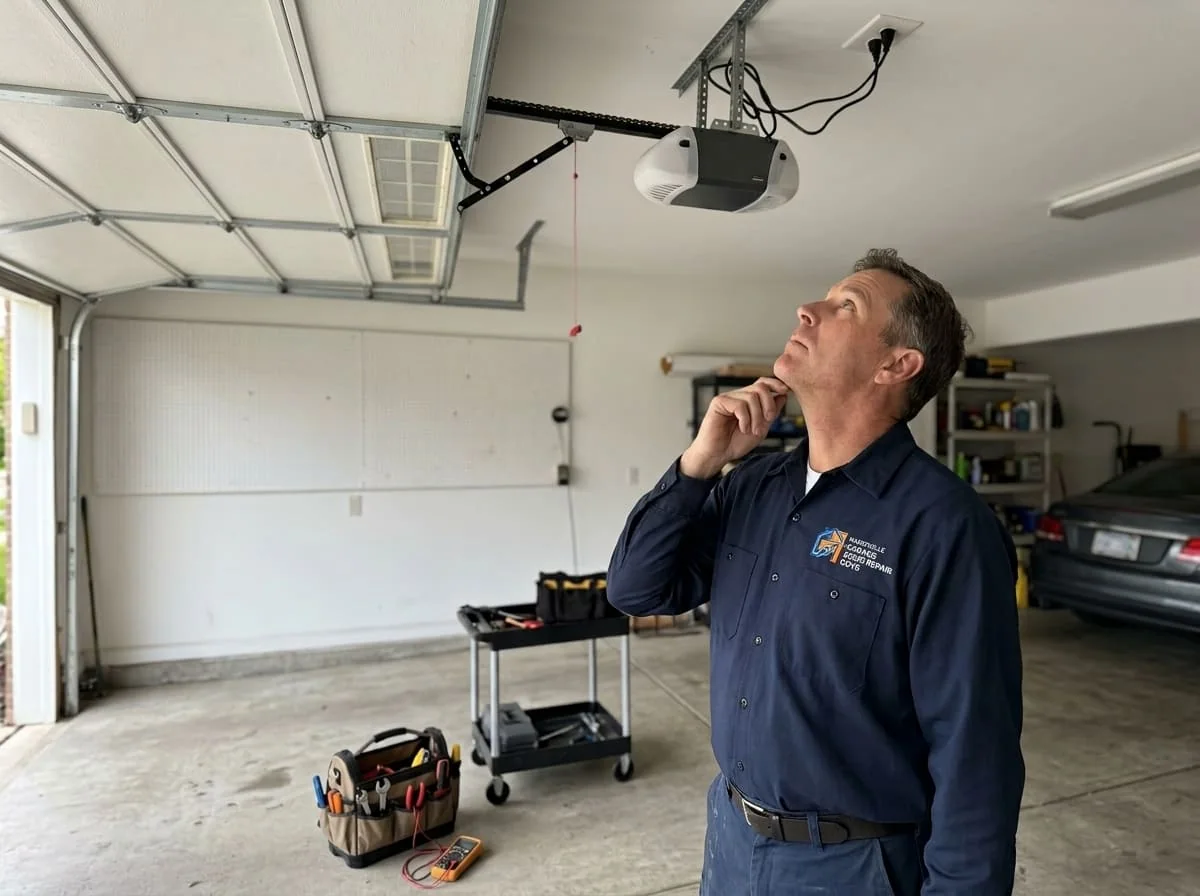
We get more calls about garage door noise than almost any other single complaint, and a surprising number of those calls trace back to opener type rather than a worn part. A lot of Naperville's newer construction, including subdivisions built around Route 59 and 95th Street, puts the garage directly beneath a second-floor bedroom or a bonus room to maximize the footprint of the lot. In an older ranch-style home, the garage might share a single interior wall with a family room instead. Either layout means opener noise isn't an abstract comfort issue, it's something the household hears every single time the door cycles, sometimes at 6 a.m. before a commute down I-88 or at 10 p.m. after a late shift.
Chain-drive openers are the loudest of the three by a meaningful margin, both in raw decibel level and in the low-frequency vibration that travels through framing rather than air, which is exactly the kind of sound that a standard interior door or a layer of drywall doesn't block well. Belt-drive openers cut that vibration substantially because the belt material itself dampens it before it ever reaches the rail. Wall-mount openers are often quieter still for a bedroom directly above the garage, since the entire drive mechanism sits at wall height near the door rather than running the full length of the ceiling.
If noise is the deciding factor, we walk homeowners through where the bedrooms and living spaces sit relative to the garage before recommending a drive type, because the right answer for a detached garage in Oswego is often the wrong answer for an attached garage under a nursery in Ashbury.
Winter in the Western Suburbs Changes the Calculus
Chicago-area winters do specific, predictable things to a garage door system, and opener choice is part of that picture even though it gets less attention than springs and rollers. With January highs typically hovering near 30°F and lows around 16°F, chain-drive lubricant thickens in the cold the same way any grease does, and a chain that isn't kept properly lubricated through the winter months will run noticeably louder and drag more than it did in July. Homeowners sometimes assume their opener motor is failing when really the chain has gone dry and gummy in the cold.
Belt-drive units sidestep that particular problem since there's no chain lubricant to thicken in the first place, which is one more reason they've become popular in this climate specifically, not just for noise. Wall-mount openers have their own cold-weather consideration: because they work by turning the torsion spring shaft directly, the springs themselves need to be in good condition and properly sized, since the opener is now relying on that spring system for more of the lifting work in tandem with the motor. A torsion spring that's already lost tension from age or from repeated cold-weather cycling puts more strain on a jackshaft opener than it would on a rail-mounted unit, which is one reason we always inspect spring condition before recommending a wall-mount conversion.
Freeze-thaw cycles that shift a concrete slab slightly can also throw off track alignment over a winter, and a door that isn't tracking true adds resistance that every opener type has to work against, regardless of drive mechanism. That's a separate issue from the opener itself, but it compounds any existing noise or strain problem, which is why we check track alignment as part of any opener consultation rather than looking at the opener in isolation.
Matching the Opener to Your Garage, Not the Other Way Around
The most common mistake we see is a homeowner picking an opener based on price or a big-box store display model without accounting for their actual garage. A few practical questions settle most of the decision:
- Is there living space above or beside the garage? If yes, lean toward belt-drive or wall-mount over chain-drive.
- Is ceiling clearance tight, or is the garage doing double duty as a workshop or gym? Wall-mount clears the overhead space entirely.
- Does the door run on torsion springs or older extension springs? Wall-mount only works with torsion systems.
- Is the door unusually heavy, oversized, or custom-built? Chain-drive typically has the most built-in margin for extra load.
- Does the door use a high-lift or vertical-lift track? Wall-mount tends to fit these configurations better than an overhead rail.
Most single-family homes in Naperville and the surrounding suburbs land on belt-drive as the practical middle ground: quiet enough to matter, strong enough for a standard insulated steel door, and straightforward to install on an existing rail-and-trolley setup. Garages with genuine clearance or spring-shaft advantages tip toward wall-mount, and detached garages or unusually heavy doors are where chain-drive still earns its keep.
Installation, Upkeep and What Actually Affects Cost
Swapping opener drive types isn't always a simple one-for-one replacement. A chain-drive-to-belt-drive swap on a standard rail is usually straightforward since the mounting points and rail length carry over in most cases. Moving to a wall-mount opener is a bigger job: it requires confirming the door runs on torsion springs, checking that the springs themselves are properly sized and in good condition, and planning the mounting location so the unit and its wiring clear the door's travel path and any parked vehicle.
We won't quote a specific dollar figure here because the real cost depends on factors that are genuinely different from one garage to the next: the horsepower rating needed for the door's weight and size, whether existing wiring and mounting brackets can be reused, whether the spring system needs any work before a wall-mount installation, and whether the homeowner wants smart-home features like smartphone control or a battery backup built in. What we can say honestly is that Naperville Garage Door Repair Guys provides a free, upfront quote before any work begins, so a homeowner knows exactly what they're paying for and why before committing to a drive type.
Maintenance differs by type, too. Chain-drive systems need periodic lubrication of the chain and a check on chain tension. Belt-drive systems need far less lubrication but benefit from an annual check of belt tension and wear. Wall-mount systems put more of the long-term burden on the torsion springs themselves, so those springs deserve closer, more regular attention, since DASMA's cycle-life standards (ANSI/DASMA 102) show that spring life is finite and shortens with heavier use or improper sizing, and a jackshaft opener asks more of that spring system by design.

Pete Voss
Owner and lead technician at Naperville Garage Door Repair Guys, serving Naperville, IL since 2012.
FAQs
Can I just swap my chain-drive opener for a belt-drive opener on the same rail?
In many cases, yes. If the existing rail and mounting brackets are in good condition and sized correctly for the door, a technician can often install a belt-drive unit on the same rail system, which keeps the job simpler than a full replacement. It's still worth having someone check the rail and header bracket condition first, since an older or damaged rail may need replacing regardless of drive type.
Is a wall-mount opener a DIY-friendly install?
We don't recommend it as a do-it-yourself project. A wall-mount opener connects directly to the torsion spring shaft, and torsion springs store a dangerous amount of tension. Working near that shaft without the right tools and training is genuinely risky, which is why the CPSC and door industry groups both treat torsion spring work as a job for trained technicians, not homeowners.
Which opener type is quietest for a bedroom directly above the garage?
Belt-drive and wall-mount openers are both meaningfully quieter than chain-drive for that layout, and which of the two is better depends on the garage itself. Wall-mount often wins on quietness since the whole mechanism sits away from the ceiling, but it only works with torsion-spring systems in good condition, so a belt-drive upgrade is sometimes the more practical choice.
Do belt-drive openers wear out faster than chain-drive openers?
Not with modern steel-reinforced belts under normal residential use. Older belt designs earned a reputation for wearing out faster, but current belts hold up well for standard single and double garage doors, including the heavier insulated steel doors common in newer construction. Very heavy custom doors are the one case where a chain still has an edge in raw strength.
Does cold weather affect opener performance in the Naperville area?
Yes. Chain-drive lubricant thickens in cold weather, which can make the chain run louder and drag more through the winter months typical of this area. Belt-drive openers avoid that specific problem since there's no chain lubricant involved. Cold also affects related parts like nylon rollers and torsion springs, which is worth keeping in mind regardless of which opener drive type is installed.
How do I know if my garage even has enough clearance for a standard opener?
A technician can measure the available headroom above the door track in a few minutes. Homes with unusually low ceiling clearance, some vertical-lift or high-lift track configurations, and garages converted into workshops or gyms are the situations most likely to need a wall-mount opener instead of a standard rail-mounted unit.
Have a Garage Door Problem Right Now?
Skip the guesswork — call Naperville Garage Door Repair Guys for a fast, honest diagnosis.